

3 Essential Systems for Local Business Success
Local Business, Marketing Systems, Small Business Growth
Every Successful Business Has These 3 Systems
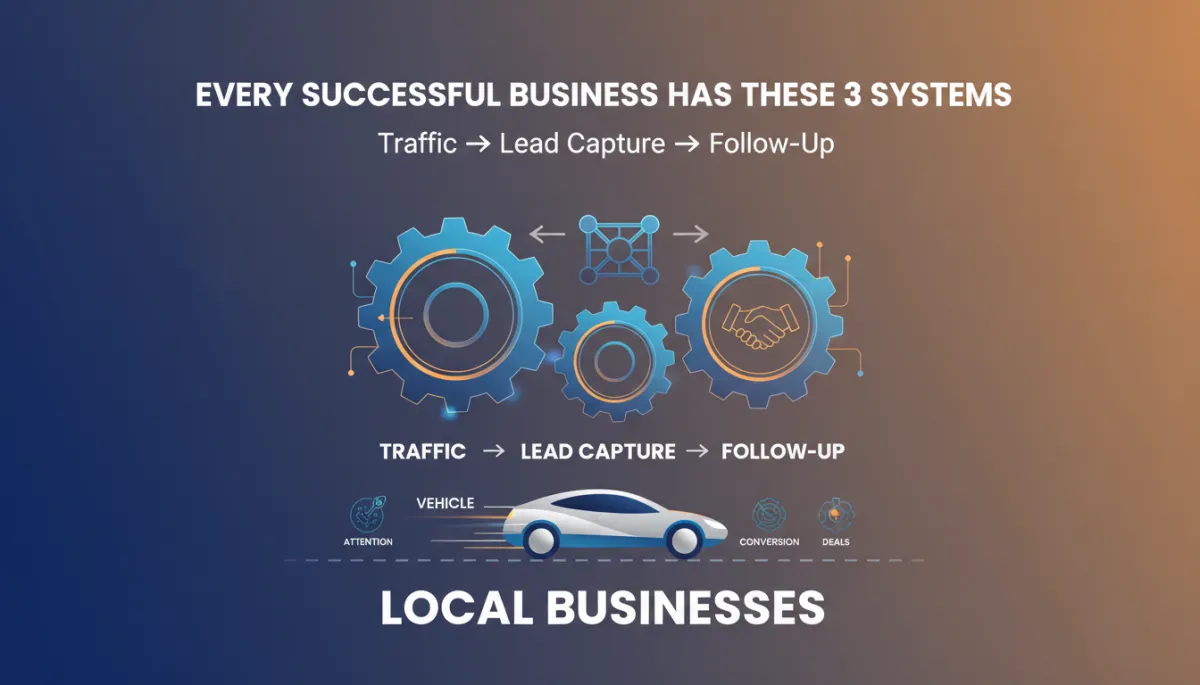
Traffic → Lead Capture → Follow-Up. When you treat these three as one connected vehicle that carries strangers all the way to “happy customer,” your local business becomes far more predictable and profitable.
Think in Systems, Not Random Tactics
Most local businesses try a little bit of everything: a Facebook post here, a flyer there, maybe a Google ad for a few weeks. The problem is not effort; it’s lack of a system. Without a simple framework, your marketing feels like pushing a broken shopping cart uphill.
Instead, think of your marketing as a vehicle. A vehicle has parts that work together to move someone from point A to point B. In business, that journey is from “never heard of you” to “loyal customer who refers friends.” The three essential systems in that vehicle are: Traffic, Lead Capture, and Follow-Up.
📌 Key Takeaway: Framework thinking turns scattered marketing activities into one clear vehicle that consistently delivers new customers.
System 1: Traffic Brings Attention
Traffic is simply people noticing you. For a local business, that might be drivers seeing your sign, neighbors scrolling past your Instagram post, or homeowners finding you on Google when they search “plumber near me.” No traffic means no attention, and no attention means no opportunity to sell—no matter how good your product or service is.
The goal of your traffic system is not to impress everyone; it’s to consistently get in front of the right people. For example:
A restaurant running local Google ads targeting “family dinner” within a 5-mile radius.
A salon posting before-and-after photos and client stories on social media.
A home services company using yard signs and local sponsorships to stay visible in key neighborhoods.
When you see traffic as the front wheel of your vehicle, you stop chasing every new marketing trend and instead ask, “Does this reliably bring the right people’s attention to my business?”
System 2: Capture Converts Visitors into Leads
Attention alone doesn’t pay the bills. Capture converts visitors into leads you can actually follow up with. This is the step most local businesses skip, and it’s where a lot of money is quietly lost.
Capture means exchanging value for contact information. That could be:
A discount or bonus for joining your email or SMS list.
An online quote form that collects name, phone, and project details.
A simple “book a free consultation” button that leads to a short form.

Turning walk-ins and website visitors into leads makes every traffic dollar work harder.
When capture is missing, your traffic system is like pouring water into a bucket full of holes. People notice you, maybe even like you, but then disappear. With a capture system, every new visitor has a clear next step that moves them deeper into your vehicle instead of drifting away.
💡 Pro Tip: Make your lead capture offer specific and simple—one clear benefit, one clear form, one clear button.
System 3: Follow-Up Closes Deals and Builds Loyalty
Finally, follow-up closes deals. This is where your vehicle delivers the passenger to the destination: a booked appointment, a signed contract, a regular table, or a long-term service agreement. Most customers don’t buy the first time they see you. They need reminders, reassurance, and reasons to act now.
A strong follow-up system might include:
A short email or SMS sequence after someone requests a quote, explaining your process and sharing testimonials.
Appointment reminders and “last chance” messages to reduce no-shows and indecision.
Post-purchase follow-up asking for reviews, referrals, or repeat bookings.
When you think in frameworks, follow-up is not an afterthought—it’s an integrated part of your vehicle. Traffic gets attention, capture collects details, and follow-up turns those details into revenue and relationships.
Putting the Framework Together for Your Local Business
The real power of this three-part framework is how simple it is to apply. You don’t need a huge budget or a marketing degree. You just need to treat your marketing as a vehicle and ask three questions:
Traffic: How are new people hearing about us every week?
Capture: What do we offer them so they share their details with us?
Follow-Up: What happens, step by step, until they buy or book?
Start by documenting what you already do in each area, even if it feels messy. Then improve one piece at a time. Maybe you tighten your Google ad targeting, add a simple lead form to your website, or create a three-message follow-up sequence for new inquiries. Each improvement makes your vehicle smoother, faster, and more profitable.
📌 Key Takeaway: You don’t need more random tactics; you need one clear vehicle: Traffic → Capture → Follow-Up.
When you adopt this framework thinking, every marketing decision becomes easier. You stop asking, “Should we try this?” and start asking, “Which part of our vehicle does this improve?” That shift is what separates local businesses that struggle month to month from those that quietly grow year after year.
