


Build a Revenue Engine for Business Growth
Revenue Engine, Lead Generation, Business Growth
Every Business Needs a Revenue Engine
Your website should generate leads automatically. Not occasionally. Not only when you launch a new campaign. Your digital presence should function like a reliable revenue engine—built with a clear vehicle objective, tuned for performance, and designed to move your business forward every single day.
Your Business Needs a Vehicle Objective, Not Just a Website
Too many companies treat their website like a digital brochure—something to admire, not something that moves. A brochure sits still. A revenue engine is built around a vehicle objective: a clear, measurable purpose that defines what your site must do to drive revenue.
Think of your business as a vehicle and your website as the chassis that carries everything forward. The vehicle objective answers one simple question: What commercial outcome should this website reliably produce? For most organizations, that outcome is leads—qualified, sales-ready conversations that feed your revenue engine.
The Engine Metaphor: Power, Parts, and Performance
An engine is more than a single component. It is a system of carefully designed parts working together to convert fuel into motion. Your revenue engine works the same way, turning traffic into leads and leads into opportunities. When you embrace the engine metaphor, you stop asking, “Does our website look good?” and start asking, “Does our engine generate enough power to hit our revenue targets?”
Fuel: Your traffic sources—search, social, email, referrals, and paid campaigns that feed your revenue engine.
Ignition: Messaging that sparks interest—clear headlines, relevant offers, and compelling positioning that align with your vehicle objective.
Cylinders: Key pages and funnels—your homepage, service pages, landing pages, and blog—compressing attention into action for your revenue engine.
Transmission: Forms, calls-to-action, and nurturing sequences that transfer power from marketing to sales without losing momentum.
When each of these parts is tuned to your vehicle objective—automatic lead generation—you no longer depend on chance. Your revenue engine becomes predictable, measurable, and improvable.
Designing a Website That Generates Leads Automatically
A high-performing revenue engine starts with clarity. Before you touch design or copy, define your vehicle objective in concrete terms. For example:
“Generate 50 qualified demo requests per month from our website.”
“Capture 100 new email subscribers per week to feed our outbound team.”
“Convert 5% of visitors on our key service pages into consultation calls.”
With a vehicle objective in place, you can engineer every element of your site to support the revenue engine:
Align navigation and page hierarchy so visitors naturally follow a path toward your primary conversion points.
Use persuasive copy that speaks to problems, outcomes, and proof—fuel that keeps your revenue engine running smoothly.
Place clear, low-friction calls-to-action where buying intent is highest, from hero sections to pricing and case studies.
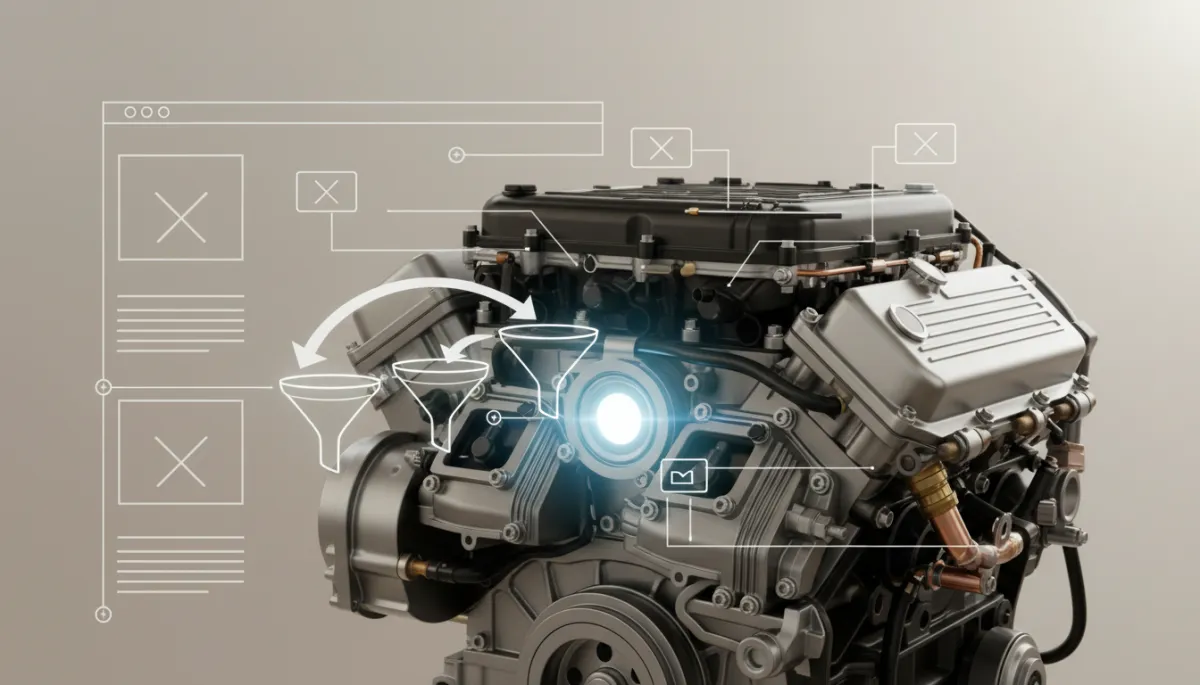
A well-designed revenue engine aligns every component around one clear lead objective.
From Manual Push to Automatic Pull
Without a true revenue engine, growth depends on manual effort—cold calls, one-off campaigns, and constant pushing. It is like trying to move a car by shoving it from behind. You might inch forward, but it is exhausting and unsustainable. When your website is engineered as a revenue engine, the motion reverses. Prospects come to you. They discover your content, engage with your offers, and raise their hands to talk.
This is the power of aligning your vehicle objective with your digital strategy. Instead of treating marketing as a series of disconnected tactics, you treat it as a system—an engine that runs whether you are in a meeting, on a flight, or asleep. Your website becomes the always-on vehicle that carries your brand, your value proposition, and your sales pipeline forward.
💡 Pro Tip: Review your analytics monthly and ask one question: “Which parts of our revenue engine are producing power, and which are just adding weight?”
Keeping Your Revenue Engine Tuned
Even the best engine needs regular maintenance. The same is true for your revenue engine. Markets shift, buyer expectations evolve, and competitors adjust their own vehicles. To stay ahead, treat optimization as a routine, not a rescue mission. Test different offers, refine your messaging, and streamline your forms. Small adjustments can unlock big gains in lead volume and quality.
Most importantly, keep your vehicle objective front and center. Every new page, campaign, or piece of content should answer, “How does this strengthen our revenue engine?” When your team shares that mindset, your website stops being a cost center and becomes what it was always meant to be: the primary vehicle for sustainable, predictable growth.
The Road Ahead
Every business, regardless of size or industry, needs a revenue engine. A beautiful website without a vehicle objective is like a sports car without an engine—impressive to look at, but going nowhere. When you commit to building a site that generates leads automatically, you are not just upgrading your marketing; you are upgrading the entire vehicle your business drives into the future.
Start by defining your objective, designing around it, and reinforcing the revenue engine mindset in every decision. Do that consistently, and your website will stop being a static brochure and start doing what it should have been doing all along—powering your growth, mile after mile.
