

Build Business Systems, Not Quick Hacks
Business Strategy, Local Businesses, Systems Thinking
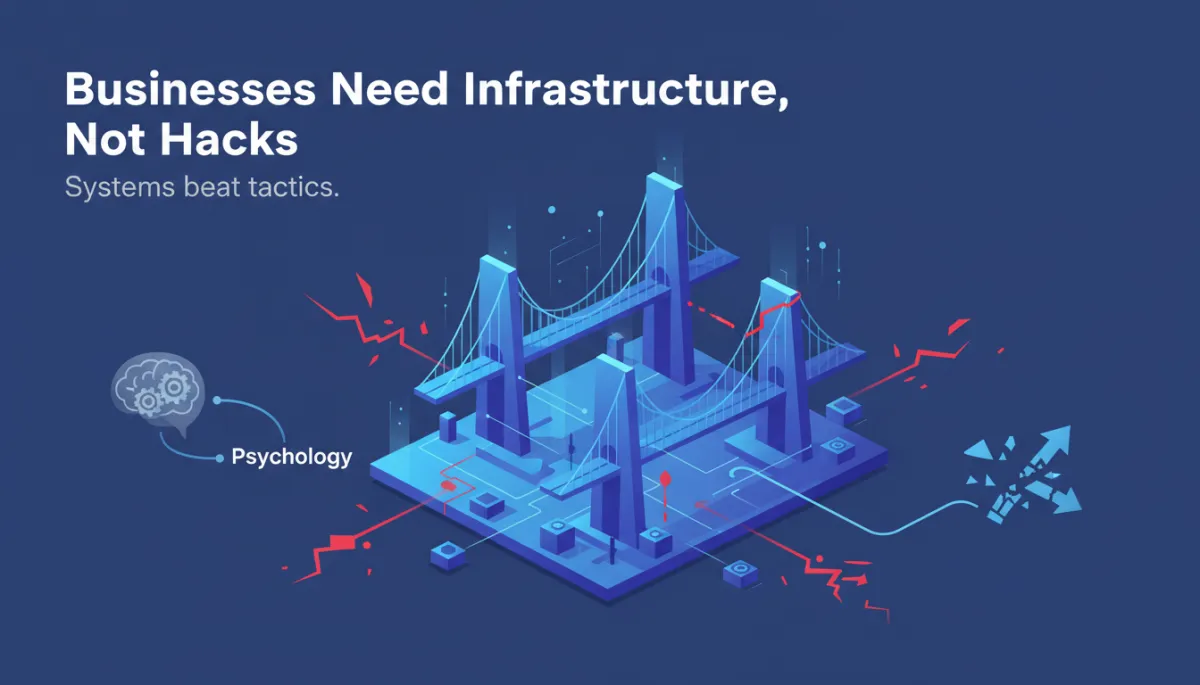
Businesses Need Infrastructure, Not Hacks
Systems beat tactics. For local businesses trying to grow, survive competition, and stay profitable, the real advantage isn’t the latest marketing trick—it’s the invisible infrastructure behind every decision, every customer interaction, and every sale.
Why Chasing Hacks Keeps You Stuck
Every week, local business owners are sold a new “hack”: a trending social media format, a clever ad script, a new app that promises more leads. Some of these tactics can work—for a while. But tactics change. Algorithms update, customer attention shifts, competitors copy you, and yesterday’s breakthrough becomes today’s background noise.
Hacks feel exciting because they offer the illusion of a shortcut. You post one viral video, run one clever promotion, and hope it transforms your business. When it doesn’t, you move on to the next trick. Over time, this creates a pattern: bursts of activity, followed by disappointment and confusion. What’s missing isn’t effort; it’s structure.
📌 Key Takeaway: Hacks can give you a spike. Only infrastructure can give you a slope.
Systems Last: The Case for Infrastructure Thinking
Infrastructure thinking asks a different question: instead of “What’s a quick way to get more customers this month?” it asks, “What system can we build so that every month, customers reliably find, choose, and return to us?” Where tactics are temporary, systems last. They create repeatable, measurable processes that keep working even when individual tactics evolve.
For a local business, infrastructure might include:
A clear, documented process for how new leads are captured, followed up with, and converted—no matter where they come from.
Standardized onboarding for new customers, so every person has a consistent, high-quality first experience.
A simple rhythm for marketing: weekly content, monthly promotions, quarterly campaigns—planned in advance and tracked.
Basic dashboards showing key numbers: leads, conversions, average order value, and repeat business.
The specific tools and tactics you plug into these systems can change over time. One year you lean on Facebook, the next on Google, the next on partnerships. But the underlying infrastructure—the way leads flow, the way customers are served, the way results are measured—remains stable and gets stronger.

When teams see the whole system, they improve results faster and more consistently.
Psychology Versus Tactics: Why Mindset Decides the Winner
Underneath the obsession with hacks is a psychological pattern: impatience, fear of missing out, and a belief that someone else knows a secret you don’t. This mindset keeps you reactive. You look outward for answers instead of inward at your own operations, customers, and capabilities.
Infrastructure thinking is a different psychology altogether. It’s grounded in ownership and long-term focus. Instead of asking, “What’s working for others right now?” you ask, “What can we build that fits how our customers behave and how our team works?” You accept that real advantage comes from compounding improvements, not sudden tricks.
This is where psychology versus tactics matters most. Two businesses can run the same promotion. One treats it as a one-off stunt. The other treats it as a test inside a larger system: they track results, document what worked, refine the process, and plug the learning back into their ongoing marketing rhythm. The tactic is identical; the mindset and the infrastructure behind it are not. Over a year, the second business quietly pulls ahead and stays there.
💡 Pro Tip: Before trying a new tactic, decide where it fits in your existing system and how you will measure its impact.
Turning Random Effort into Repeatable Results
For local businesses, the shift from hacks to infrastructure doesn’t require huge budgets or complex software. It starts with mapping what already happens in your business and tightening the weak links. Where do most enquiries come from? What happens in the first 24 hours after someone contacts you? How do you encourage a first-time buyer to come back a second time? These are system questions, not tactic questions.
Document one core process. Choose something critical—like handling new enquiries—and write down the ideal steps from start to finish.
Add simple checkpoints. Decide what you will track: response time, conversion rate, or follow-up completion.
Train your team. Make sure everyone follows the same steps so results become predictable, not accidental.
Then test tactics. Only after the system is clear should you plug in new ads, offers, or channels and see how they perform.
Superiority Comes from Structure, Not Secrets
In crowded local markets, the businesses that quietly dominate are rarely the loudest or flashiest. They are the ones with strong infrastructure: clear processes, consistent customer experiences, and a leadership team that thinks in systems, not stunts. Their superiority isn’t a mystery; it’s the natural outcome of structure.
Tactics change, systems last. When you build infrastructure—operational, marketing, and customer experience systems—you create a business that can absorb new tactics, adapt to new platforms, and outlast trends. While others chase the next hack, you’ll be busy building something far more valuable: a business that works, predictably, even when you’re not chasing it.
The choice is simple: keep gambling on short-lived tricks, or invest in the infrastructure that turns every tactic into a repeatable advantage. For local businesses that want to lead—not just keep up—systems will always beat hacks.
